How to Make Your Digital Communications More Human
When I worked in a traditional corporate setting, there was nothing I loathed more than preparing for some paid time off and setting an autoresponder message that sounded like this:
Hi,
I’m out of the office and will return on Wednesday, May 27th. For urgent matters, please contact [team member name]; otherwise, I’ll get back to you upon my return.
Thank you,
Alyssa
It’s a boring, cold, and impersonal message often disguised as one that sounds “professional” and “prevents oversharing about one’s personal life.”
Think about how you feel every time you receive one of these messages. You may not even realize how many of these you’ve received because they aren’t memorable and offer little to no value, aside from letting you know you won’t receive a response in the near future.
We spend an enormous amount of time (I’m scared to even pull research on how much) in our digital communications channels — our inboxes, calendars, browsing websites, scrolling social media platforms, and more. And yet, we agonize over larger pieces of content, like long-form writing, presentations, pitches, and formal introductions, all while completely ignoring the smaller ones that can have just as big an impact.
Your everyday digital communications are prime real estate for letting your personality and voice shine. I’ll show you how to be more “you” in these spaces.
Why infusing your personality matters in digital communications
Have you ever met or followed someone online and met them virtually or in real life, only to find out they’re nothing like what they seemed? That’s precisely why I encourage you to sprinkle as much of your humanness into your digital communications as possible; to bridge the gap between how you act and who you are (because these don’t need to be different).
And a few other key reasons why adding your personality to these digital spaces matters more than you think:
- Unique is memorable; generic is forgettable. We’re inundated with information every single day. I don’t know about you, but I’m guilty of overlooking anything that sounds or feels mildly generic (ahem, or fully AI-generated), cold, or impersonal. But I don’t forget the people or communications that feel unique in their own right.
- Being yourself is the differentiator. There’s enough AI-generated content (and then some) to go around. Sounding genuinely like yourself (using your own darn voice) is increasingly rare but exponentially valuable. Your digital communications are one of the easiest ways to highlight who you really are.
- “Personal brands” and what have you. I have mixed feelings about “personal branding” and about everything we do becoming part of a “personal brand.” What happened to everything we do being part of who we are?! Regardless, every out-of-office (OOO) message, email signature, calendar invite, and social one-liner is a micro-impression. We’re going to make an impression anyway, so we might as well make it count with intention.
- Consistency builds real relationships. When someone reads your email signature, then gets an OOO message from you, and reads more about your background on your website — and they all sound like the same person — you build trust, and, more importantly, authentic relationships.
Where can your personality live in your digital communications?
Most people think about "voice" in the context of big content, but there are several smaller daily opportunities worth not overlooking.
Some frequently used touchpoints worth considering, depending on the nature of your work, include the following:
Email signature, aka daily communications real estate
Your email signature is one of the most visible and most frequently seen pieces of digital real estate you have, yet we usually treat it as a one-time setup task. Instead of defaulting to your name, title, and a couple of links, think of it as a small space where you can say something meaningful about how you work.
What to consider: links that actually matter to you (your website, portfolio, or newsletter), a short line about how you work or what you value, or a single sentence that invites connection and engagement. Small, intentional choices here can make your signature feel like an extension of your personality rather than just a formality.
Here’s my current email signature:
Alyssa Towns
Freelance Writer, Words with Alyssa LLC
✏️ Work with me at Words with Alyssa
🕰️ Writing in honor of Janet, Dale, and John at Time Intentional
☕ Grab my free Values Workbook (and support my work with caffeine)
I include a link to my website (where you’re reading this), a link to my newsletter, Time Intentional, and a link to my free values workbook (a Time Intentional free download). Emoji-led one-liners break up the text. Below the three links, I include a below-note signature (more on that next).
Below-signature notes, or a rotational one or two-liner worth including
Often, this is the only area for custom messaging that corporate professionals have when they must follow a standard email signature format. If your organization locks down your signature format, the line or two beneath it might be the one place where you can sound like yourself.
What to consider: a short note about your response times (which you can edit seasonally or as your schedule changes), upcoming OOO dates so people can plan around your availability, a land acknowledgment (which I’m seeing a lot more of and can be a meaningful way to ground your work), causes you care about, a current “hot” project you’re excited about, or a gentle plug for your newsletter or latest work. Rotating this note every few weeks or months keeps it fresh and gives people a reason to pay attention instead of scanning past it.
Here’s my current below-signature note:
Hey, you! I'm responding at a time that works best for me, and I encourage you to do the same! Emails can wait. The good stuff in life shouldn't ✨
This line is directly below the “Grab my free Values Workbook (and support my work with caffeine)” line shown above. As a freelancer, it’s not uncommon for me to send emails during “non-traditional hours.” But I never want someone to feel pressured to respond to me urgently.
OOO messages, aka one of the most overlooked pieces of content
We tend to write out-of-office messages on autopilot as a to-do list item, but they are among the few messages those reaching out to you will almost always open (even if only for a quick peek before deleting them). This makes them a surprisingly powerful way to convey not only logistics, but also a bit of who you are.
What to consider: start with the basics — let people know when you’ll return or, at the very least, when they can expect a response from you. Once you’ve covered that, pivot into personality. Share what you’re enjoying right now, like books you’re reading, podcasts you’re loving, or products you can’t stop recommending.
You might link to recent work you’re proud of, a fundraiser you’re supporting, or a cause that matters to you. You can also tell a brief story, make the reader smile, leave them with a big idea to think about while you’re away, or invite them to reply (for example, “Hit reply and tell me what you’re reading lately”). The options here are genuinely endless, and they don’t have to be long to be memorable.
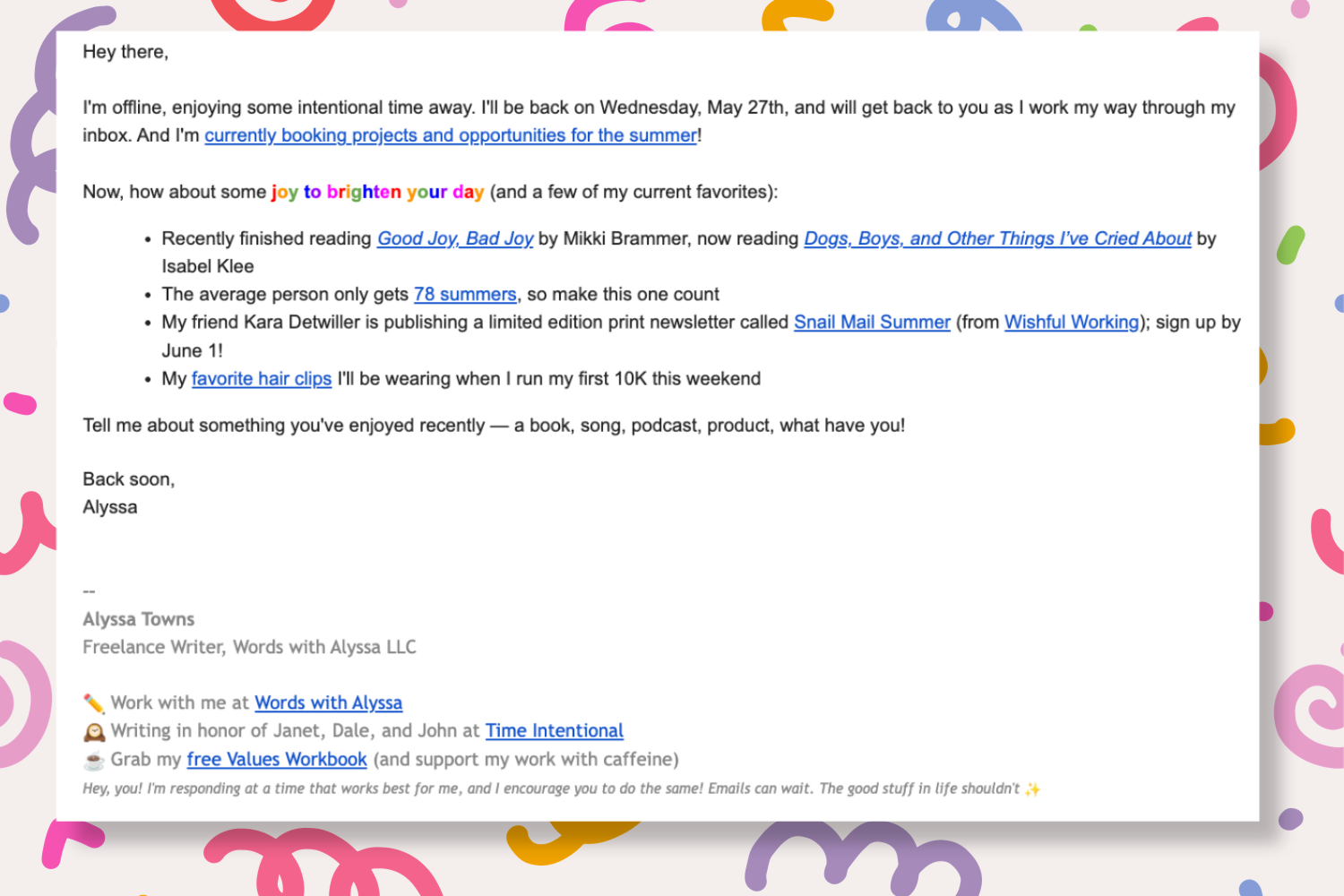
I recently took some time off for a long weekend. Here’s the OOO message I set while I was away:
Hey there,
I'm offline, enjoying some intentional time away. I'll be back on Wednesday, May 27th, and will get back to you as I work my way through my inbox. And I'm currently booking projects and opportunities for the summer!
Now, how about some joy to brighten your day (and a few of my current favorites):
- Recently finished reading Good Joy, Bad Joy by Mikki Brammer, now reading Dogs, Boys, and Other Things I’ve Cried About by Isabel Klee
- The average person only gets 78 summers, so make this one count
- My friend Kara Detwiller is publishing a limited edition print newsletter called Snail Mail Summer (from Wishful Working); sign up by June 1!
- My favorite hair clips I'll be wearing when I run my first 10K this weekend
Tell me about something you've enjoyed recently — a book, song, podcast, product, what have you!
Back soon,
Alyssa
Here's a screenshot of the OOO message (with my signature below it) for the full effect:
Calendar invite descriptions
Calendar invites are another space people tend to ignore, but you should never leave them blank, regardless of how much personality you insert. But your description box is an opportunity to set expectations, create clarity, and add warmth before meeting or chatting on the phone.
What to consider: a warm, human greeting; a sentence or two of context about why you’re meeting; and a simple note about how you show up and how attendees can (or should) show up, too. For example, you might write, “Casual conversation—no need to prepare anything,” or “Cameras optional; come as you are.” These small cues not only reflect your personality but also reduce others' anxiety and set the tone for more human interaction.
My default calendar invites typically include some version of:
I look forward to chatting with you! If there's anything I should know before we chat, please reach out.
Know that you're in a safe, cozy space here. I frequently show up in leisure wear with a messy bun or a hat. Bring your best, comfortable self (no judgment!).
Chat app statuses (e.g., Slack status)
Status messages are tiny but mighty. You may be required to follow a standard format, especially in more traditional environments, but in many cases you still have some room to sound like yourself.
What to consider: choosing an emoji no one else uses and becoming known for it, updating your status daily or weekly with a fun fact, quote, or short message, or writing traditional status updates (OOO, do not disturb, busy) in your own voice.
I’m no longer a daily Slack user, so I don’t have any current examples to share; however, one of my loved ones shares a daily trivia fun fact, which is a great idea.
LinkedIn headline
Your LinkedIn headline follows you everywhere on the platform: comments, connection requests, search results, and more. Treat it like a tiny billboard that travels with your name. It can be so much more than your job title and organization, “Ex-” anything, or a bunch of fluffy keywords.
What to consider: fun one-liners that capture what you actually do, humorous or clever takes on your role, or a more holistic snapshot of who you are professionally (with a hint of personal flavor). You can also include interests that serve as conversation starters, such as “New runner, DM me your training tips.” The goal is to help people understand you quickly and feel like they’re getting a real person, not just a job title.
Here’s my current LinkedIn headline (which I change and experiment with often):
Writer, storyteller, and occasional journalist ✐ Internal comms specialist trained in change management ✰ Writing Time Intentional in honor of Janet, Dale, and John ⋆·˚ ༘ * I hope something good happens to you today ✿
Email subject lines
Most of us write our subject lines seconds before hitting send, but they are your first impression. Over time, they can become a recognizable part of your voice.
What to consider: creating a small bank of subject lines in your voice for your most common email topics (status updates, introductions, follow-ups, thank-yous), and experimenting with slightly more playful or human subject lines where appropriate. You don’t need to be clever all the time (clarity matters), but a small twist can make your messages feel more personal and less like every other email in someone’s inbox.
Here are some email subject line examples from my personal bank:
- Pitching writing work / internal comms support and expertise
- A writer who gets internal comms (and has the clips to prove it)
- Your next favorite internal comms writer
- Freelance IC writer — a few ideas for [company name]
- IC writing support — minimal onboarding required
- Need IC help? I’m here for you
- Time Intentional outreach
- A newsletter about time (the one thing we can’t get back)
- Time is non-refundable; are you spending yours wisely?
- What Time Intentional readers love right now
- Time Intentional, in honor of my late grandparents
- Not your average newsletter about time
- Follow-ups and warm outreach
- Checking in — no pressure, not urgent
- Wanted to share something fun with you
- A quick note (the good kind)
- Something I thought you’d enjoy
- No agenda; just saying hi!
Author or speaker bios (if you have them)
Most people write a bio (or a couple of versions for different character requirements) and reuse it everywhere, which makes it a powerful place to infuse their personality. Instead of a dry list of accomplishments, your bio can read like a mini-story about who you are, how you work, and what you care about.
What to consider: pairing your expertise (credentials, roles, results) with a few personal facts or tidbits that show you’re a human being beyond your job title. This might look like mentioning where you live, what you love doing outside of work, or a quirky detail that helps people remember you.
Here are a couple of my bios floating around the internet:
Alyssa Towns works in communications and change management and is a freelance writer for G2. She mainly writes SaaS, productivity, and career-adjacent content. In her spare time, Alyssa is either enjoying a new restaurant with her husband, playing with her Bengal cats Yeti and Yowie, adventuring outdoors, or reading a book from her TBR list.
On Anna Dearmon Kornick’s website:
Alyssa Towns is a freelance writer and communications specialist who helps brands create better workplaces through thoughtful writing and change-focused internal communications. She has worked closely with C-suite executives, managed large-scale initiatives, and written for publications including The Everygirl, Grammarly, Clockwise, and Business Insider.
After experiencing the loss of three grandparents in their sixties, Alyssa’s perspective on time shifted dramatically. Those experiences inspired her belief that life is too short to wait to live fully.
She writes Time Intentional, a weekly newsletter exploring what it means to live with purpose, presence, and clarity in a world that constantly pulls us toward autopilot.
This list is non-exhaustive, so these may or may not apply to you and your work. And you may even identify spaces that align better with what you do. Use these as a starting point to help you develop your own list of digital communication playgrounds.
How to develop your digital communication voice principles
Now, before you start adding notes and messages to your digital communications willy-nilly, I recommend spending some time developing your voice principles. The goal is to provide a throughline of consistency and authenticity, not slap random notes together here and there and create more confusion about who you actually are.
Uncovering your voice and digital communications goals
Before you write a single word of copy, you need to know what vibes and outcomes you are going for. Creating a short persona voice reference guide is an easy way to capture what you want to achieve.
Spend half an hour or less walking through the following prompts to develop your starting point:
- What do you want people to feel after interacting with you digitally?
- Comfortable? Energized? Empowered? Uplifted? Reassured? Like they're talking to a friend they’ve known for years?
- What do you say in person that never makes it into your digital communications?
- For many of us, there’s a gap between how we write and how we speak. Notice that gap. What do you say in person that might bear repeating (or at least translating in some way) in your digital communications?
- What are you genuinely interested in outside of work?
- Remember, you’re a human first! That’s nice that you have a wide range of professional interests, but it’s okay to share more about what else you enjoy, too. Some ideas: books, hobbies, your morning coffee ritual, the podcast you can't stop recommending, or what you’re looking forward to on your vacation.
- What permission do you want to give people?
- This one is underrated, but several years ago I added a note below my email signature about responding when it makes sense for the reader. I want people to know I never expect immediate responses or replies during set hours. (This comes from a pressure to respond quickly during my corporate days.) What permission do you wish you had that you want to give? Maybe it's, “Don't over-prepare for our call.” Or, “Ask me anything.” Or, “I keep short hours on Fridays and you should too.”
- What's one thing about how you work that would make someone more comfortable working with you?
- Similar to the first question, I recommend thinking deeply about how you work and what you can share to make others feel comfortable engaging with you. I work from home and often work out in between writing assignments, so it’s not uncommon for me to show up to a video call wearing a hat and barre clothes. I like to let people know they are welcome to show up as their best selves, no “professional” attire necessary.
Turning your voice and digital communications goals into principles
Using your answers to the prompts above, you can develop a set of overarching principles to guide your digital communications. Below are some of mine:
Principle | In Practice |
Digital = in person | The Alyssa you meet online will be the same way you meet on a call or in person |
Intentionality over default | I don’t do things on autopilot, including (and importantly) my communications |
Time Intentional lives everywhere | Time Intentional is a core expression of my values and how I show up; I weave it into my work naturally |
Zero performance | I am who I am, and I want you to be yourself around me |
Time is sacred | Time is non-refundable, and I respect others’ timelines |
Rotation wins | I’m not afraid to experiment and change my communications |
Digital communications practices to live by
As you develop your digital communications voice and let your personality shine, keep the following practices in mind:
- Specific always beats general. Name the book or the person or the feeling. "I love coffee" is forgettable. "Nespresso-fueled” is specific and makes people say, “Me too!” or “What’s your favorite pod flavor?”
- Give permission. The most generous thing you can do in a professional communication is to be upfront about who you are, what you expect, and how you can work together comfortably.
- Rotate things. Especially if you choose time-bound references such as “currently reading,” it’s important to make sure you are, well, currently reading what you claim to be reading. Set reminders to update your digital communications guide and spaces as needed.
- Don't perform — just be you. The goal isn't to seem interesting or make things up that “sound good.”
Start with one thing. Pick the touchpoint you interact with most and make it more you. Then move to the next one.
Cheers to making digital communications feel more human
The most radical thing you can do, especially in a world drowning in similar-sounding, soulless content and information, is just sound like yourself. Consistently. Even (and especially) in the small, often overlooked places in your digital communications.
0 Comments Add a Comment?